
Air in a heating or cooling system can contribute to noisy pipework, cold spots, poor circulation and unnecessary strain on system components. However, not all air within a system behaves in the same way.
An automatic air vent and a deaerator both help remove air, but they perform different roles. Understanding the difference is important when selecting the right protection for a system.
What does an automatic air vent do?
An automatic air vent, such as the SpiroTop, removes free air that has collected at a specific point within the system.
Free air naturally rises and can become trapped at high points or inside components such as boilers, heat exchangers and buffer vessels. If it is not released, it can restrict circulation and contribute to noise and cold spots.
Installed where air is likely to collect, an automatic air vent allows it to escape without the need for repeated manual bleeding. The SpiroTop is designed with a large air gap between the valve and the system water, helping to protect the valve mechanism against contamination and reduce the risk of leaks.
What does a deaerator do?
A deaerator, such as the SpiroVent, removes circulating air and microbubbles from the system water as it flows through the unit.
These small bubbles do not necessarily rise to the highest point of the system. Instead, they can continue circulating through the pipework, pumps, emitters and heat source. This means they may never reach an automatic air vent.
Inside a SpiroVent, the water passes through the SpiroTube separation element. This creates the conditions needed for microbubbles to separate from the water, rise into the collection chamber and be released automatically.
By continuously removing circulating air and microbubbles, a deaerator helps reduce air-related noise, repeated manual venting and disruption to system circulation.
What is the difference?
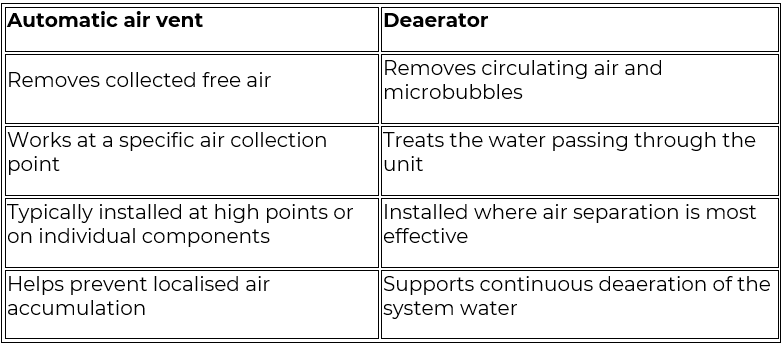
The important distinction is that an automatic air vent can only release air that reaches and collects at its installation point. It cannot separate microbubbles that remain within the circulating system water.
A deaerator is specifically designed to remove these smaller circulating bubbles before they can collect elsewhere or continue passing through system components.
Does a deaerator replace every automatic air vent?
Not necessarily. Automatic air vents and deaerators are not competing products; they perform different and often complementary functions. Automatic air vents remain useful at points where free air is likely to collect.
A deaerator provides wider system protection by removing circulating air and microbubbles from the system water.
Depending on the system design, the most effective approach may be to use both.
Why is positioning important?
Even the correct product must be installed in the right position.
An automatic air vent should be located where free air naturally collects, such as a high point in the installation or on a boiler, heat exchanger or buffer vessel.
A SpiroVent deaerator should be installed where air is most readily released from the system water. In a heating system, this is normally at the hottest point—typically where the water leaves the heat source. In a cooling system, it is generally where the water enters the cooling unit.
Correct positioning allows the product to operate effectively and provide reliable air removal.
The key difference
An automatic air vent removes free air that collects at its installation point. A deaerator removes circulating air and microbubbles from the system water.
They perform different roles, so installing an automatic air vent does not provide complete system deaeration. For effective air management, the system may require correctly positioned automatic air vents, a deaerator, or both.
For advice on air removal, deaeration or selecting the right product for an installation, speak to a Spirotech specialist.